Project 3
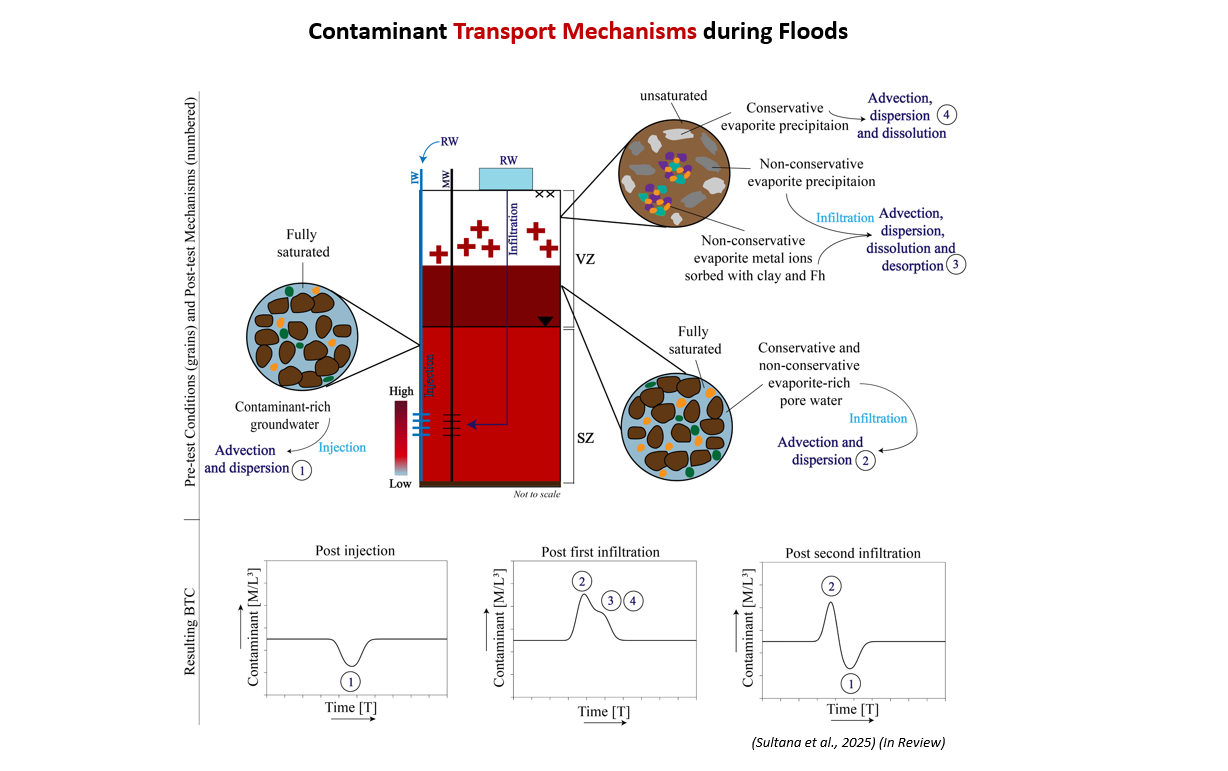
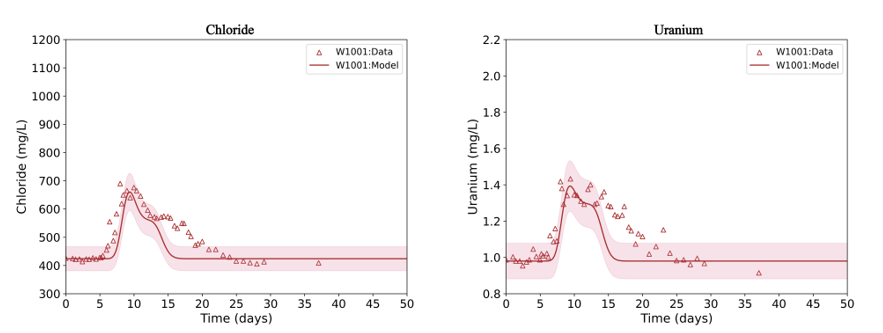
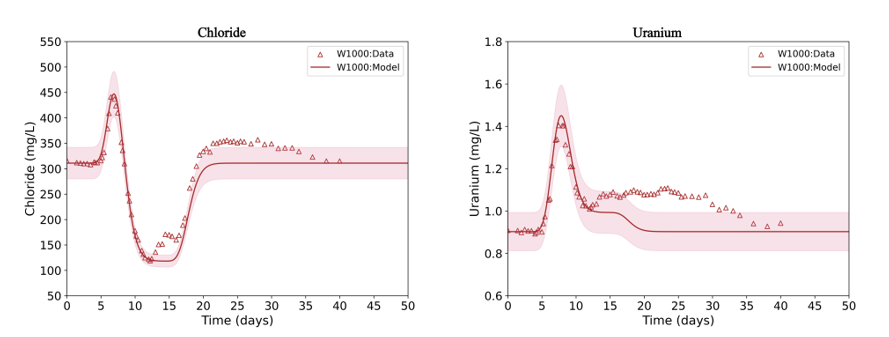
Infiltration events, such as natural river flooding or managed aquifer recharge, can mobilize contaminants, such as chloride and uranium stored in the vadose zone. Quantifying contaminant transport during these events is challenging due to the changing nature of flow and solute movement in the vadose zone. Field tracer experiments, one direct injection into the saturated zone and two surface infiltration experiments through the vadose zone, identified two primary contaminant mobilization mechanisms: (1) non-reactive transport of contaminant-rich pore water ahead of the wetting front and (2) dissolution of contaminant-rich evaporites by infiltrating water. In this study, a one-dimensional mathematical model was applied to inversely simulate the field data and quantify the relative contributions of these mechanisms. The injection test showed that advection and dispersion dominated uranium and chloride transport in the saturated zone, indicating it was not a substantial source of contaminant mobilization. In the first infiltration test, both uranium and chloride were initially mobilized by advection and dispersion of contaminant-rich pore water, followed by dissolution of contaminant-rich evaporites, with uranium desorption, in the vadose zone. In the second infiltration test, chloride transport was primarily driven by advection and dispersion of chloride-rich pore water, while uranium transport occurred via initial advection and dispersion followed by dissolution of uranium-bearing evaporites with uranium desorption. The results confirmed the hypothesized mobilization mechanisms and demonstrated that the vadose zone is the primary source of contaminant release during infiltration events. These insights into transport mechanisms are crucial for evaluating contaminant behavior and designing effective remediation strategies.
Rakiba Sultana, Corey D. Wallace, Aaron D. Tigar, Timothy J. Wahl, Kendyl N. Hoss, Raymond H. Johnson, Charles J. Paradis. 2025. Mechanisms for Contaminant Transport in the Vadose Zone During Infiltration Events. Journal of Contaminant Hydrology. (In Review)
🔗 View Code on GitHub
Hasan, A.B.M.R., Sultana, R., Paradis, C.J., Pillai, K.M., 2025. Experimental investigation of upward and downward cycling of salt contaminants in the vadose zone. Journal of Contaminant Hydrology 104686. https://doi.org/10.1016/j.jconhyd.2025.104686